
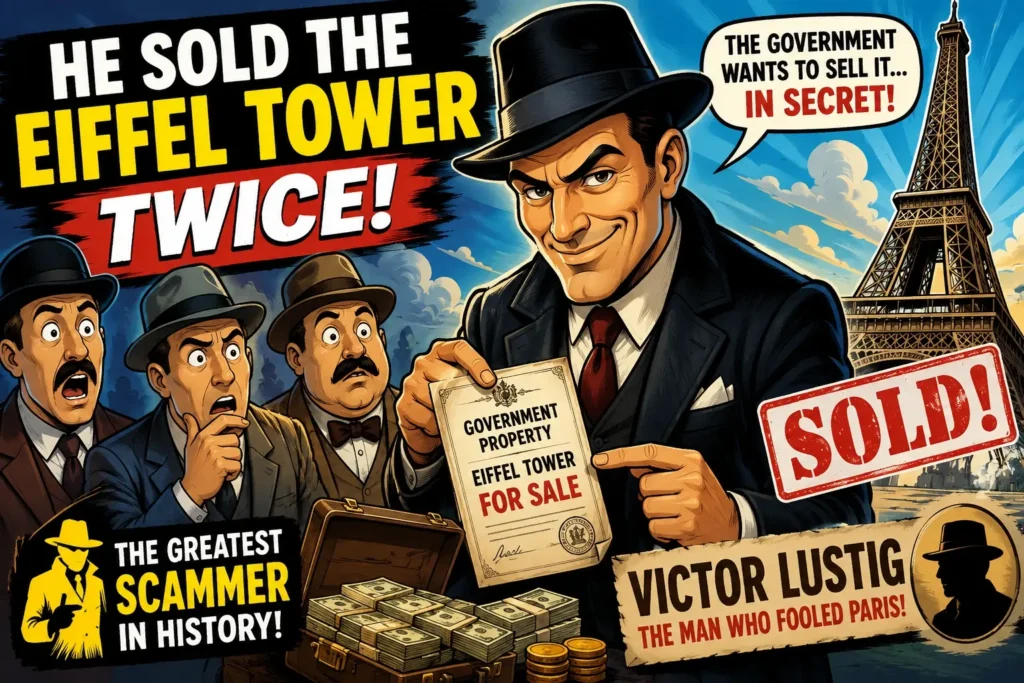
In the glittering heart of 1920s Paris, where champagne flowed like rivers and the Eiffel Tower ruled the skyline, a man named Victor Lustig was quietly preparing the greatest scam the world had ever seen.
Victor didn’t look dangerous. He dressed like a gentleman, spoke with elegance, and carried himself with the confidence of a government official. But beneath the polished smile was a mastermind who understood one thing better than anyone else:
People believe what they want to believe.
In 1925, newspapers across Paris began discussing the enormous cost of maintaining the aging Eiffel Tower. Rust was spreading. Repairs were expensive. Some politicians even suggested tearing it down.
To most people, it was just another headline.
To Victor Lustig, it was opportunity.
Using forged government documents and stolen official stationery, Victor invited several wealthy scrap metal dealers to a luxurious meeting at the famous Hôtel de Crillon. The men arrived nervous but excited. Waiting for them was Victor, posing as a high-ranking French government official.
He spoke calmly, confidently.
“The government,” he explained, “has decided to secretly sell the Eiffel Tower for scrap metal.”
The room fell silent.
The dealers could hardly believe their luck. The Eiffel Tower itself — one of the greatest monuments on Earth — was supposedly up for sale. Victor told them the deal had to remain confidential to avoid public outrage. That secrecy made the lie even more believable.
Among the dealers was a businessman desperate to climb Parisian high society. Victor noticed the man’s insecurity immediately. He knew greed alone wasn’t enough — ambition was the real hook.
So Victor added another layer to the deception.
Hinting that government contracts often required “personal incentives,” he subtly asked for a bribe. Instead of becoming suspicious, the dealer felt relieved. Corruption made the entire story feel authentic.
Within days, the businessman handed over a fortune in cash.
And just like that, Victor Lustig had “sold” the Eiffel Tower.
The moment he received the money, Victor vanished.
He escaped to Vienna before the victim even realized he had been tricked. Humiliated and terrified of public embarrassment, the businessman never reported the crime.
Most con artists would have disappeared forever after a success like that.
Victor Lustig did something unbelievable.
He returned to Paris…
…and tried to sell the Eiffel Tower again.
This time, however, one of the targets grew suspicious and contacted police. Victor narrowly escaped capture and fled Europe for the United States, where his legend only grew larger.
In America, Lustig continued his criminal career with astonishing boldness. He created counterfeit money schemes, manipulated wealthy investors, and even tricked notorious gangsters. One story claimed he convinced Al Capone to invest money in a fake business deal — only to later return the untouched cash and earn Capone’s trust and admiration.
Victor understood psychology better than crime itself. He knew that confidence could overpower logic, that appearances could defeat suspicion, and that intelligent lies wrapped in authority often sounded more believable than truth.
For years, law enforcement chased him across continents. But Victor always seemed one step ahead — changing identities, forging documents, charming strangers, and escaping danger with impossible timing.
Eventually, his luck ran out.
After years of fraud and counterfeiting, federal agents finally captured Victor Lustig in the United States. The man who had fooled businessmen, aristocrats, gangsters, and governments was sentenced to prison and sent to the infamous Alcatraz Federal Penitentiary.
There, behind cold iron bars, the world’s smoothest con artist spent the final years of his life.
But his legend never died.
To this day, the story of Victor Lustig remains one of history’s most unbelievable true tales — not because he stole money, but because he convinced intelligent people to hand it over willingly.
And somewhere in the streets of Paris, beneath the shadow of the Eiffel Tower, the ghost of the greatest scam ever told still lingers.
Leave a Reply